
























As course selections are well underway, many students at Norwood High School have begun to feel the pressure that comes along with deciding what classes to take and how to balance their years. One such decision that may seem daunting to a majority of students is whether or not to take Advanced Placement (AP) classes, with information surrounding the coursework and functions of AP classes being mostly unknown.
But why are these courses surrounded by such uncertainty, and why do they even matter in the first place?
What is Advanced Placement?
To explain why these AP courses are so valuable, it is important to first understand what the Advanced Placement Program actually is and what each class entails. AP classes are fast-paced classes run by the College Board with a set material and course given to teachers and schools who sign up for the course. While the classes go over material that is largely similar to that of an honors or college-level class, AP classes move much faster and include a greater amount of review, building up to an AP Exam in May that tests students on their knowledge of everything they have learned throughout the course.
This AP Exam, graded and administered by the College Board, is a test that varies from class to class, challenging the skills that students build throughout the year. To illustrate this dynamic, the AP Exam for a class such as AP US History would have a multiple-choice section and an essay section, testing students’ ability to analyze sources and come to conclusions given historical evidence. On the other hand, an exam for a STEM course such as AP Physics would have a different style of multiple-choice questions that challenge students’ understanding of core physics concepts and ideas, as well as a free-response section that requires students to apply their knowledge to hypothetical situations.
Although different from class to class, these exams are all graded on a scale from 1-5, with 1-2 being considered a non-passing grade and 3-5 being considered a passing grade. For many of these classes, the percentage of students who do not pass the AP exam is much smaller than the percentage of students who pass, with a passing grade being much more attainable than most would expect, given the right amount of effort and hard work.
This exam is the primary focus and goal of the class, with many of the tests and most critical thinking done in these classes being created in a way that mimics the exam and builds the skills necessary to earn a passing score.
However, one important thing to understand is that the outcome of the AP exam and the score a student receives does not affect their grade or the high school credit they receive. The AP score is simply a merit; a number that the College Board gives students to reflect how well they did in the class. A good score on the exam can be used in a student’s college resume to make themselves look better, but that is about it. A bad score does not make any difference and can be easily disregarded if the student does not wish to share their score.
This allows students to focus on their in-school grade rather than worrying about an AP Exam, granting them a chance to receive a decent grade if they are willing to put in the work.
The two exceptions to this theme are the AP Capstone classes AP Seminar and AP Research, which are heavily focused on research and presentation projects completed throughout the year. In these classes, a student’s in-school grade is mainly based on completion of these tasks.
Norwood High School offers 27 AP classes, with courses in all subjects available to all students who meet the grade requirements and have received a recommendation from their teachers.
Although this information is well known to the teachers and students of these classes, many underclassmen and people considering taking AP classes are often left in the dark regarding the benefits of these classes and their difficulties. This lack of available information has been mostly caused by a lack of communication between past AP students and students deciding on their classes, a problem that has turned many away from taking AP classes in fear of the unknown.
The AP Ambassador Program
This problem had been consistent until the creation of the AP Ambassador program in the 2025-2026 school year by Laura Mullen, the AP Coordinator here at NHS, and Erin Reegan, an NHS guidance counselor.
“It is a way to get students who are AP students and are doing well in AP classes to share their experiences,” said Mullen. These conversations provide “an inside look from a student perspective on what AP classes are all about.”
The program allows students who are willing to give guidance to their peers a chance to express their growth and shortcomings to an audience of people who need it most. These AP Ambassadors come from all walks of life and various AP classes, giving a variety of different testaments on how the AP program has been for them.
“It is a positive community of students of all ages that take AP classes,” said Junior Aryanksh Parida, an AP Ambassador.
With its diverse member base and strong core values, this program has been proven to be quite effective in providing the inside look that it advocates for.
Billie Hayes, an AP Physics teacher and someone who has experienced the AP Ambassador Program firsthand, believes that the AP program “has kind of a scary [stigma] with it” but that through their insights, “these AP Ambassadors take down the [stigma] that goes with it by explaining their own experiences”.
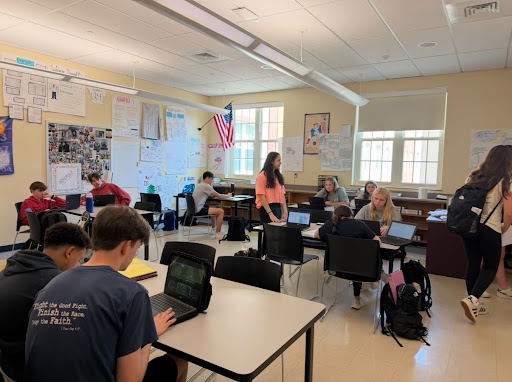
These conversations take place in various different manners and settings. In its most basic function, teachers of a class that leads to an AP course in the next year ask an AP Ambassador who has taken that next level to come into the class and advocate for why these students should take it. In these speeches, ambassadors described the positives and negatives of individual AP courses and how students could benefit from them.
“We show our experiences with the ups and downs of the classes and the benefits that students can gain from them,” said Parida.
In addition to the speech, students are encouraged to ask AP Ambassadors any questions or concerns they may have about AP classes. These conversations are crucial to ensuring that students are given the correct perspective on what an AP class is like and how successful they might find themselves if they take it.
“Teachers have such a different perspective than the students,” said Mullen. “Students know what students care about and what students are concerned about.”
Not only can these conversations take place in classes that are registered for one of these meetings, but they can happen anywhere. Students who are questioning taking an AP class are encouraged to reach out to their guidance counselors and ask to get in contact with an AP ambassador who would be able to address their concerns.
Why should students consider taking AP classes?
AP courses are a very valuable opportunity provided to the students of Norwood High School, yielding many benefits and lessons that are crucial to taking that next step in education.
“If you are planning on going to college, it matches the fast pace of the learning material and having to challenge yourself in a competitive environment,” said Parida.
For students considering entering college or gaining a higher level of education, AP courses can mimic what the experience of most college courses would be like. They require students to build strong critical thinking and time management skills, two very important traits that allow students to thrive in college.
Not only that, but a passing score on the AP Exam can allow students to gain college credits before they enter college, saving time that would be spent taking college courses — and lots of money, though this offer varies from college to college. Students should consider looking into which colleges accept which scores as credit to decide on the classes that would most benefit their time and wallets.
In addition, students can gain much more from the classes than just the knowledge that comes along with the course and the college credit earned from passing the course.
“In meeting with the AP Ambassadors and interviewing some of [them],” said Mullen, “it seemed like you all obviously learned a lot, but you also got a lot out of the class too”.
These below-the-surface benefits come in many forms, with Mullen highlighting some common experiences of “meeting a lot of different people that you wouldn’t have met before” to gaining “test-taking and study skills” that allow students to enjoy the classes and succeed at the same time.
In many cases, AP students find themselves in the same classes as other students taking multiple AP classes, allowing them to build stronger relationships with their peers through the shared experiences and struggles of multiple AP classes. The fast pacing of these classes also forces students to reflect upon their work ethics and build stronger studying skills that will allow them to maintain a strong grade.
These benefits are very attainable to all students who are willing to put in the work and keep up with the difficulty of the class.
“The important thing is being confident in yourself and using your time management skills,” said Parida. “Even for tests and homework, if you are not consistent with whatever you are doing over time, [the class] will start to get worse.”
Students should make sure they stay on top of all of their work, because if they start falling behind, the late work will build up very quickly. That being said, many of these AP teachers are well-experienced with AP students and their struggles and are open to accepting late work from their students. In order to ensure that work and time is spent evenly throughout the year, students should aim to complete all of their work in the time that they are given rather than letting the late work build up and bog them down.
“It’s something that they could try if they are willing to work hard,” said Mullen.
How to get started
Given all of this information, AP classes may begin to seem more achievable. They are available to a majority of students at NHS, with the only thing standing in between a student and an AP class being doubts and questions about what these classes would actually be like.
Despite these worries, students are being encouraged by this program to take those next brave steps in their education and challenge themselves through AP classes.
“Students should always try and strive for greatness,” said Hayes, encouraging students to “rip off the band-aid, jump in the deep end, get it done, go have fun, see what the unknown is like!”
To take this big step and decide what AP classes would best suit them, students should take initiative and speak to their guidance counselors and get in contact with AP Ambassadors to discover which AP classes would best suit them and their goals for the future.
“Talk to an AP Ambassador,” said Mullen.
If you have any questions regarding an AP class or the AP Ambassador Program, make sure to reach out to any of the AP Ambassadors or me at [email protected]. They’d love to hear from you and provide input on whatever your questions may be.
Going forward, the AP Ambassador Program will continue to experiment and find new ways to promote their stories to those who need it most. As the program increases in numbers, its message and goals will only become stronger.
Regarding the students considering taking AP classes or who are doubting their abilities, believe in yourselves. With enough hard work and dedication, these classes can be some of the most rewarding and educational experiences of your high school career. So challenge yourselves, plan for your futures, and grow as people. That next step in your lives is only one conversation away.