



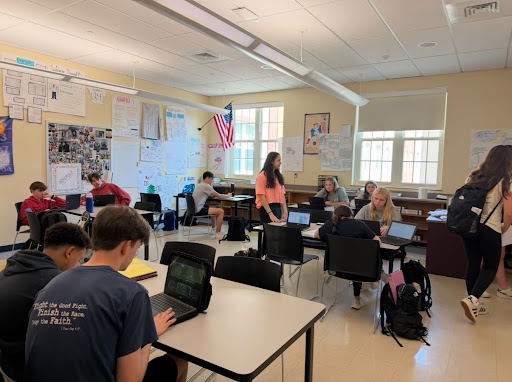


















Now more than ever, topics dealing with political decisions are turning into conversations frequently brought up in classroom settings. Students come to school every day with hundreds of questions they hope their teacher will be able to answer. These questions are based on the information they gather on social media. TikTok has been a growing platform and one of the main sources of news for teenagers. TikTok is just one of the untrustworthy online app that provides viewers with these ideas.
This problem has brought up the worry that newer generations and even previous generations have started to rely too much on the first story, which is often fake news, to get their information from. These observations are where journalists come in.
Journalism is the practice of writing in order to inform readers about factual information, and that is what separates it from the rest of the news these days. Journalists are known for going into this line of work not to get popular or become a household name, but to keep untrue details out of the minds of those who might share it.
Many don’t see the underlying problem with sharing opinions they might think are fact-based, but with more knowledge, the world is a more stable place. The economy, security, and perspectives can all be influenced, which can then create hatred and a corrupted society.
Recently, the newsworthy story that has been gaining multiple different views is the inflation that has ties to tariffs and our relationships with other countries. Many have taken the lead in order to come up with ideas on why their totals at checkout are through the roof. The facts of the piece are that the most recent announcement on a change in price was made on products from countries that have previously traded with Iran. This piece of information has turned into news spreading about upcoming wars and caps never being put on items. None of these have been proved accurate and creates an unnecessary worry that just launches the reason for other misinformation topics.
In an essay written by A.G. Sulzberger that was first published in Columbia Journalism Review titled Journalism’s Essential Value, which was later shared with the New York Times, began with “As long as independent journalism has existed, it angered people who want stories told their way or not at all.”
Journalists are in charge of keeping an unbiased view on any coverage they may be in charge of, but, as this quote says, many of the readers in the general public don’t understand this and get easily frustrated that they can’t directly connect with the text.
Later in the piece, he writes, “American journalism faces a confluence of challenges that present the most profound threat to the free press in more than a century. News organizations are shrinking and dying under sustained financial duress.”
To fully understand the art of journalism, you have to understand that it gets all of its ability from the First Amendment right of free speech and the press. Going on any online newspaper, you can clearly see the different types of articles allowing for voices to be heard or just breaking news events to be covered, giving only the information.
A popular common theme that has been the reason people are getting upset with larger news websites is the surrounding cause of why they are not trusted when a civilian wants to get clear news fast. They want to click on an app like Instagram that they know has never made them upset, and just search for an answer to the question they have. They continue to follow the first link that pops up, and the cycle starts from there.
So next time you have a question about a discussion you saw the President had or a picture of an attack that is claimed to have taken place in the US, go to the closest news site and read a real article written by a professional journalist because, at the end of the day, that is their job and they know how to do it right.