









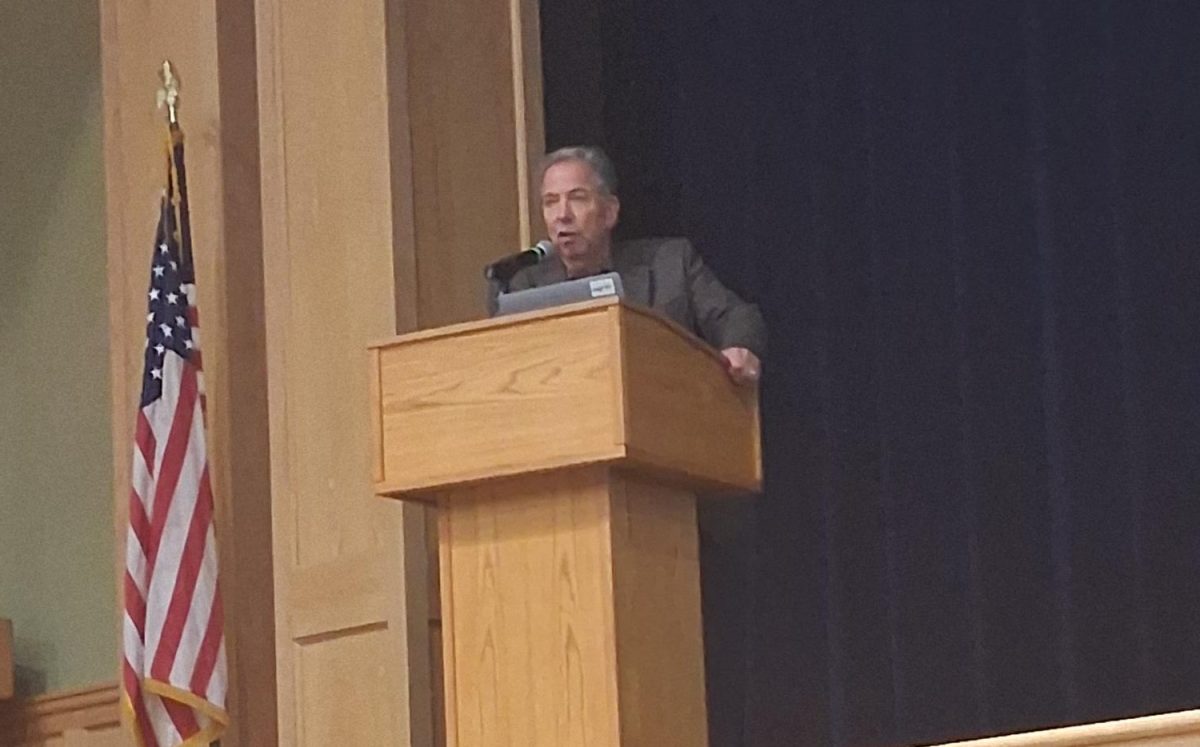
On Friday, March 27, World History students sat in a quiet auditorium and experienced something far more powerful than just another school assembly. Bernie Furshpan, the son of a Holocaust survivor, visited and shared a ninety-minute documentary about his family and his father’s experience. While the documentary was about history, it was also about loss, fear, memory, and responsibility for the newer generations to remember and share these stories
The center of the documentary, Moshe Furshpan, who was only 10 years old when he experienced the worst thing that anybody could experience. Moshe escaped a concentration camp and lived in the woods for 3 years, living off only mushrooms, tree bark, and berries. While his survival is unbelievable, it did come with a huge cost.
“My father was the only survivor of a family of 8 people,” Bernie Furshpan explained. “I didn’t have cousins or grandparents or aunts or uncles.”
However, his message wasn’t only about the past, but also about how to help the future leaders. Bernie emphasizes the importance of leadership.
“One day, when you’re at work or at school, you won’t be popular. You’ll be alone. Make people feel special by sitting with them. That’s how leaders are mad.” He added, “A true, organic leader is someone who doesn’t think about themselves but for others.”
Furshpan also reflected on how his parents’ experiences shaped his own identity.
“They walked into the buildings to look for exit signs, and I do the same thing. I didn’t know why, but I realized when I was older, they were always anxious, like something wrong could happen. You could say nah that it couldn’t happen here, but they said the same thing back then, and it did happen, so yeah, it changed me a little bit.”
Despite his hopeful message, Furshpan did not ignore the reality of ongoing hatred in the world before and even today.
“Apparently, we haven’t learned anything since 55 million people were killed by genocides since the Holocaust. We keep repeating the same cycle of hate.”
He also reminded students that despite our different lives, we have a lot in common.
“We still throw rocks and stones and sticks at each other and say bad things, but it doesn’t make sense. This is the best we can come up with. We can do better.”
Furshpan kept comparing hate to a disease, explaining that “hate is like cancer,” he explained. “Our body makes over 4 quadrillion cells in an average lifetime. And with just one cell, our body can get cancer if it reproduces quickly enough. That’s the same with hate. With one person who hates another, it becomes a chain reaction.”
For Furshpan, sharing his family’s story is not just about educating others, but also telling others makes him remember memories of his father and everything that was lost.
“I would love to go back and see how my father grew up,” he says.
Today, only around 196,000 Holocaust survivors remain, spread across under 90 countries. Because of this, Furshpan makes it a part of his daily life to keep their stories alive and not to have the past be repeated. While he continues to approach others with kindness, the lessons of the past remain with him and his stories.
“I do trust people, I’m very kind and generous to people, but it’s always in the back of my mind that you know you gotta be careful. Hate still exists. Why? What’s the point in all the hate?”
When the assembly came to an end, Bernie Furshpan shared final parting words that are important for everybody to hear:
“Be kind to one another. Do great things to make the world a better place.”